

The Short Answer: An AC blowing hot air, cycling on and off constantly, or racking up repeated repair bills is telling you something. When those signs start stacking up, replacement is usually the smarter financial move over another repair.
If your air conditioning has been struggling lately, you are not alone. Central Florida homeowners put their AC systems through a lot, running them nearly year-round in heat and humidity that most systems are not designed to handle indefinitely. Some problems are worth repairing, others are a sign that the system has reached the end of its useful life. This guide walks through the five clearest signs it is time to stop patching and start planning for a new AC system.
Sign 1: Your AC Is Blowing Hot Air
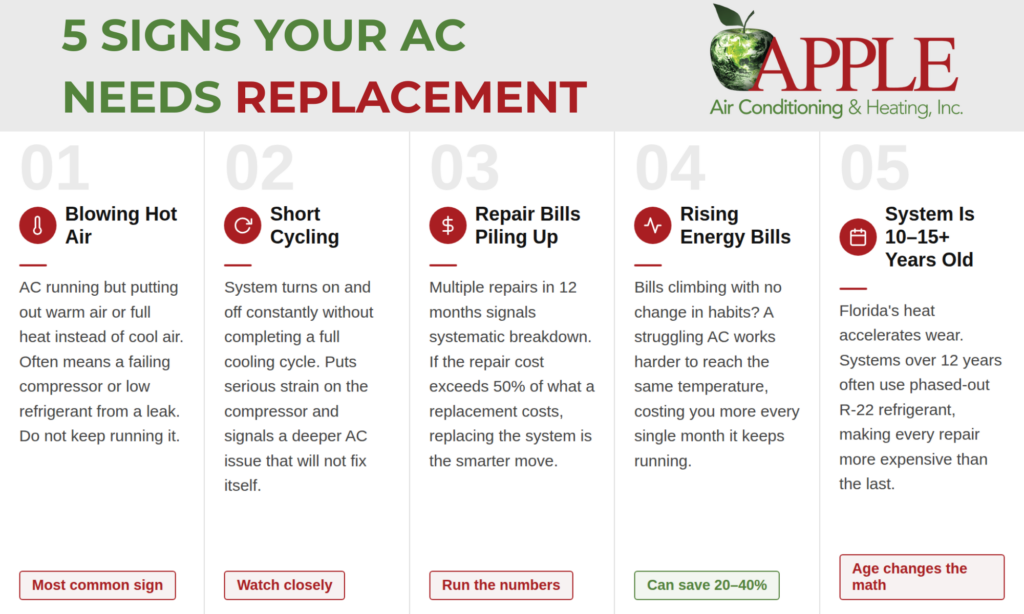
This is the most common complaint we hear, and it is also one of the most telling signs of a deeper AC issue. When your air conditioner is running but putting out warm air or full heat instead of cool air, the system is not doing its one job.
A few things can cause hot air from your vents:
- Low refrigerant: The AC system relies on refrigerant to absorb heat from inside your home. Low refrigerant from a leak means the system cannot produce cold air no matter how low you set the temperature setting. A refrigerant recharge without fixing the leak is a temporary fix at best.
- Failing AC compressor: The compressor is the heart of the system. When it starts to fail, the AC cannot properly pressurize the refrigerant, and you end up with warm air or no cool air at all. A new compressor can cost $800 to $2,500 on its own. On an older system, that cost often tips the repair vs. replace calculation toward replacement.
- Faulty expansion valve: The expansion valve regulates refrigerant flow through the system. A stuck or failed expansion valve can cause the evaporator coil to ice over or the system to blow warm air entirely.
- Condenser coil issues: A dirty or damaged condenser coil blocks heat from leaving the system, which pushes warm air back into the house instead of cool air.
If pressing the AC button produces nothing but hot air, start with a professional diagnostic before throwing money at parts. A qualified technician can tell you quickly whether it is a fixable component or a sign the whole system is going.
Sign 2: The System Is Cycling On and Off Constantly
Short cycling, meaning the AC turns on and off every few minutes without completing a full cooling cycle, is hard on every component in the system. It stresses the compressor, wastes energy, and leaves your home inconsistently cooled.
Common causes include:
- An oversized system that cools the space too quickly and shuts off before properly dehumidifying
- A failing pressure switch or refrigerant issue causing the system to trip off as a safety measure
- A failing blower motor that cannot move enough air across the evaporator coil
- Electrical issues, including a blown fuse or wiring problem
Short cycling on an older system is worth a diagnostic call. If the cause is a failing compressor or a refrigerant leak that has been repaired once before, that pattern of recurring breakdowns usually points toward replacement rather than another repair.
Sign 3: Repair Bills Are Adding Up
One repair is normal. Two in the same year starts to add up. Three or more in a couple of years is a pattern, and that pattern has a real cost.
A helpful way to think about it:
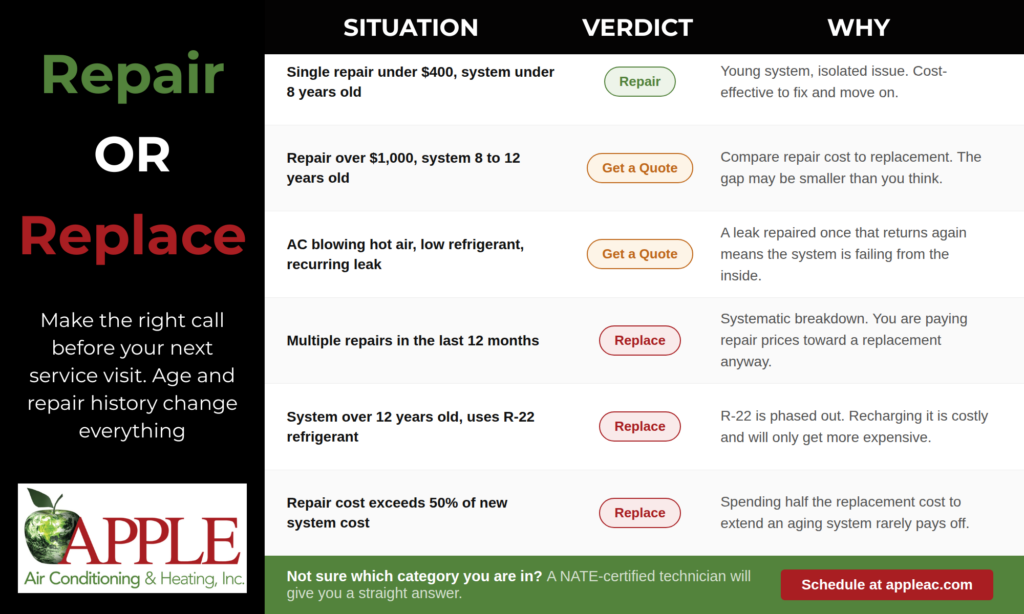
| Situation | What It Usually Means |
| Single repair under $400 | Likely worth fixing |
| Repair over $1,000 on a system older than 10 years | Compare to replacement cost |
| Multiple repairs in 12 months | System is breaking down systematically |
| Repair cost exceeds 50% of replacement cost | Replace |
The general rule used by HVAC technicians: multiply the repair cost by the age of the system. If that number exceeds $5,000, replacement is usually the better investment. A new AC installation with a 10-year parts and labor warranty gives you predictable costs instead of surprise bills.
Sign 4: Your Energy Bills Keep Climbing
An AC system that has to work harder to reach the same temperature setting uses more electricity. If your energy bills are rising and your usage habits have not changed, the HVAC system is a likely cause.
Signs your system is losing efficiency:
- Takes longer than usual to cool the house to the ambient temp you set
- Runs constantly without the house reaching the temperature on the control panel
- Certain rooms are noticeably warmer than others even with the system running
- You notice the AC issue gets worse on the hottest days, when the system is under maximum load
An older AC system running below its rated SEER efficiency can cost significantly more to run each month than a modern replacement. According to the U.S. Department of Energy, replacing an older low-efficiency unit with a modern high-efficiency system can reduce cooling energy use by 20 to 40 percent. In a Central Florida home running AC most of the year, that adds up fast.
Sign 5: The System Is More Than 10 to 15 Years Old
Age alone does not mean replacement, but it changes the math on every repair decision. Most residential AC systems have a lifespan of 12 to 15 years in Florida’s climate. The heat and humidity here accelerate wear on the compressor, evaporator coil, and condenser coil faster than in cooler climates.
If your air conditioner is in that 12 to 15 year range, here is what to factor in:
- R-22 refrigerant: Systems manufactured before 2010 use R-22, which has been phased out of production. Recharging an R-22 system is expensive and getting more so. A refrigerant leak on one of these systems often makes replacement the only cost-effective path.
- Parts availability: Older systems take longer to repair because parts are harder to source. That means more time without cool air waiting on a fix.
- Error codes and thermostat issues: Older systems paired with aging AC controllers or thermostats can throw error codes that are not worth diagnosing when the system itself is near end of life.
- Warranty status: Most manufacturer warranties expire at 10 years. Once the extended warranty window closes, every repair comes out of pocket.
If your system is 12 years or older and showing any of the signs above, a conversation about replacement options is worth having before the next breakdown happens.
Repair or Replace: A Quick Reference
When to Call an AC Shop vs. Wait It Out
Some AC issues have a straightforward fix. A tripped fuse box breaker, a dirty air filter blocking the blower motor, or a simple thermostat miscalibration can all cause the system to underperform without needing major work.
Before assuming the worst, check:
- That the thermostat is set to cool, not heat
- That the air filter is not completely clogged
- That the circuit breaker for the AC has not tripped
- That all supply vents are open
If those check out and the system is still blowing warm air or not cooling, that is the point to call a technician. A trained HVAC technician can run a full diagnostic, check refrigerant levels and pressures, inspect the evaporator coil and condenser coil, and give you an honest answer on whether repair or replacement makes more sense for your specific situation.
Ready for an Honest Answer? Talk to Apple AC.
An AC blowing hot air, short cycling, or racking up repair bills is not something to put off in Central Florida. The longer a failing system runs, the more strain it puts on every remaining component.
Apple AC has proudly served homeowners throughout Central Florida since 1997. As a family-owned and operated company, we take pride in providing honest service, dependable workmanship, and lasting comfort solutions for our customers. Our NATE-certified technicians are available 24/7, supported by a strong team, fully stocked warehouse, and a large fleet of service vehicles ready to serve all of Central Florida and the surrounding communities. Our service area includes Winter Garden, Clermont, Kissimmee, Orlando, Ocoee, Winter Park, Apopka, Lake Mary, and surrounding areas.
We are strong supporters of Daikin and Carrier for their quality, innovation, and long-term reliability, but our experienced team can install, service, and maintain all major HVAC brands and systems. Whether you are weighing repair versus replacement or simply looking for trusted guidance, we will always provide straightforward recommendations and dependable service you can trust.Call us at (407) 654-3777, request a free estimate, or schedule service online today. At Apple AC, we do more than just talk about great service. We show up, stand behind our work, and treat every customer like family. Whether you need a quick repair, routine maintenance, or a complete system replacement, our team is ready to help keep your home comfortable year-round.