


The Short Answer: NATE certification means an HVAC technician has passed rigorous, industry-recognized testing that proves real-world competency. Hiring a NATE-certified technician lowers the risk of mistakes, reduces callbacks, and gives you better service on something as important as your home’s cooling system.
When you let someone into your home to work on your HVAC system, you are trusting them with your comfort and your investment. A Florida home without working air conditioning is not just uncomfortable; it can become a health issue fast. Knowing how to tell a qualified technician from someone who just picked up a wrench matters. NATE certification is one of the clearest signals that an HVAC technician has put in the work to prove their skills and establish their HVAC career. Here is what that actually means and why it should factor into who you hire.
What Is NATE Certification?
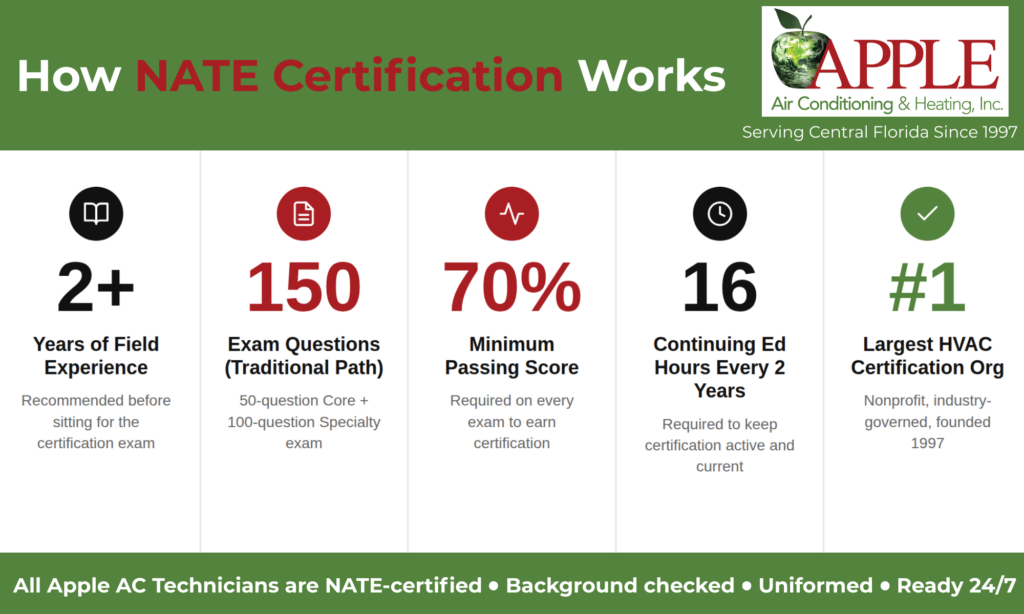
NATE stands for North American Technician Excellence. Founded in 1997, it is the nation’s largest nonprofit organization dedicated to certifying heating, ventilation, air conditioning, and refrigeration technicians. NATE operates as an independent certification organization, which means its exams are not written by manufacturers trying to sell equipment. The standards come from industry experts across the country.
A NATE-certified technician has passed at least one certification exam that tests real-world working knowledge of HVAC systems, not just textbook theory. That distinction matters because an HVAC system in the field behaves differently than one in a classroom.
How the NATE Certification Process Works
There are two pathways to earning NATE certification:
The Traditional Pathway
The traditional route requires passing two exams:
- The Core Exam: A 50-question test covering HVAC system fundamentals, safety, tools, and industry standards. A score of 70% or higher is required to pass.
- A Specialty Exam: A 100-question exam focused on a specific area such as air conditioning, heat pump systems, gas heating, air distribution, or refrigeration. Technicians choose the specialty that matches their work, and again must score 70% or higher to pass.
The CHP-5 Pathway
The Certified HVAC Professional pathway breaks certification into five 30-question exams covering HVAC Fundamentals, Electrical and Controls, Comfort and Airflow, Installation, and Service. Technicians can take them in any order and have up to six months between exams to study and prepare.
Entry-Level Certificates
For an entry-level technician earlier in their career, NATE also offers the Ready-to-Work Certificate and the HVAC Support Technician Certificate. These are not full certifications, but they show that a newer technician is on the right path and working toward full NATE certification.
Renewal Requirements
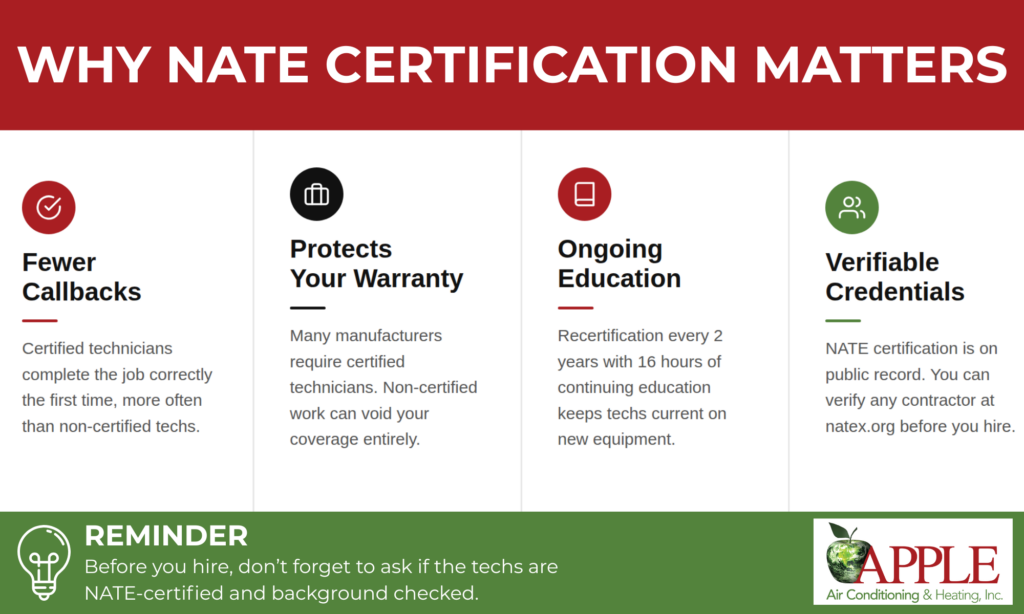
Certification does not last forever. NATE-certified technicians must earn 16 continuing education hours every two years to maintain their certification, or retake their specialty exam. That ongoing education requirement means a NATE-certified tech is keeping up with changes in the HVACR industry, including new refrigerants, updated equipment, and evolving installation standards.
What the Exam Actually Tests
The certification exam is not a multiple-choice quiz on basic facts. NATE’s exams are built from Knowledge Areas of Technician Expertise, or KATEs, which are developed through job task analysis by working HVAC professionals across the country. Every question on every exam is tied directly to something a technician actually needs to know on the job.
For a service technician specializing in air conditioning, that includes:
- Diagnosing why an AC system is not cooling properly
- Understanding refrigerant levels, pressures, and leak detection
- Inspecting and testing electrical components safely
- Troubleshooting heat pump systems, ventilation, and airflow issues
- Knowing when a repair is appropriate versus when replacement is the better call
These are not skills you can fake. A technician who passes a NATE certification exam has demonstrated that they can apply that knowledge to real equipment.
Why It Matters for Homeowners
Fewer Callbacks
Research from within the HVACR industry consistently shows that NATE-certified technicians generate fewer callbacks than non-certified technicians. A callback means something was missed or done incorrectly the first time, which costs you time, money, and days without a working cooling system. Hiring a certified technician increases the odds that the job gets done right the first time.
Your System Lasts Longer
Poor installation and sloppy maintenance work shorten the life of an HVAC system. An improperly charged system, a misdiagnosed refrigerant leak, or a heat pump set up incorrectly will wear out components faster than normal. A NATE-certified technician understands how each part of the system interacts and is far less likely to cause problems while trying to fix one.
Warranties Can Depend on It
Many HVAC manufacturers require that installation and service work be performed by certified technicians to honor warranty claims. If a non-certified contractor installs your system or makes a repair that voids the warranty, you are on the hook for costs that should have been covered. According to the U.S. Department of Energy, hiring a contractor who holds industry-recognized HVAC certification is one of the most important steps homeowners can take when replacing or servicing their system.
Better Service Overall
A certified technician brings more than just exam knowledge. The rigor of preparing for and passing a NATE certification exam builds discipline, attention to detail, and a deeper understanding of HVAC systems than field experience alone can provide. When something unexpected shows up on a service call, that preparation pays off.
What to Ask Before Hiring an HVAC Contractor
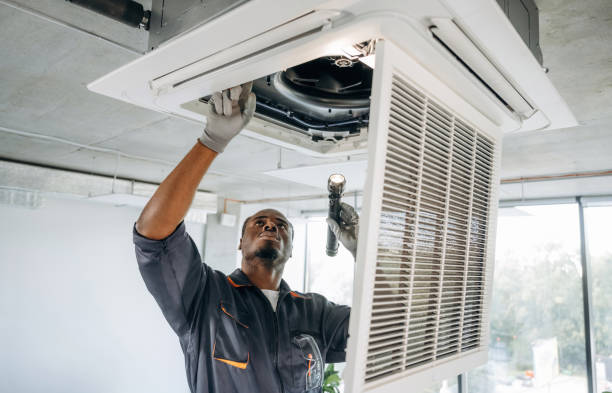
Not every HVAC contractor employs NATE-certified technicians. Some hire general tradespeople or entry-level technicians without putting them through the certification process. Before scheduling service, it is worth asking:
- Do your technicians hold NATE certification?
- Which specialty certifications do they hold?
- How do you handle ongoing education and recertification?
- Are your technicians background checked?
A reputable HVAC contractor should be able to answer all of those questions clearly. If they hesitate or cannot confirm NATE certification, that is worth noting.
You can also verify NATE certification directly through the NATE website, where contractors can be listed as part of their Consumer Contractor Connection program once at least 25% of their eligible service and installation technicians are NATE certified.
The Apple AC Standard
At Apple AC, every technician we send to your home is NATE-certified. That has been our standard since we started, and it is not something we treat as optional. We are an authorized dealer for York, Amana, and Daikin, and we offer new AC installations backed by 10-year parts and labor warranties. That warranty means something, and it holds up because our techs do the work correctly the first time.
We serve Orange, Lake, Seminole, Osceola, and Sumter Counties, including Winter Garden, Clermont, Orlando, Kissimmee, Ocoee, Apopka, Lake Mary, and surrounding communities. Every tech who shows up at your door has passed a background check, and you will get a text with their name and photo before they arrive. If you need service, a free estimate, or want to ask about our service agreements, call us at (407) 654-3777 or schedule online. We do more than just talk about service.