


The Short Answer: SEER stands for Seasonal Energy Efficiency Ratio, a number that tells you how much cooling output your air conditioner produces for the energy it uses over a typical cooling season. The higher the SEER rating, the less energy your unit uses to keep your home comfortable, which means lower energy bills and a smaller carbon footprint.
Anyone shopping for a new air conditioner in Florida runs into the same question fast: what does SEER rating mean, and how high should it really be? The number affects what you pay every month, what your AC can handle on a 95-degree afternoon, and how long the equipment will last before it needs replacement.
This guide breaks down SEER in plain language, explains the newer SEER2 testing standards, and walks you through choosing the right SEER rating for a Central Florida home or business.
What Does SEER Rating Mean?
SEER is short for Seasonal Energy Efficiency Ratio and it describes how much cooling output an air conditioning system delivers compared to how much electricity it uses across a typical cooling season.
The math is simple:
-
- Cooling output is measured in British Thermal Units (BTUs) of heat removed from your home
-
- Energy consumption is measured in watt-hours of electricity used
-
- SEER = total BTUs of cooling divided by total watt-hours of energy
A higher SEER means you get more cooling per watt. A lower SEER means the system burns more electricity for the same result. That is why a 17 SEER air conditioner is more efficient than a 14 SEER unit, even if both can cool your house on a hot day.
To estimate your savings, try Apple AC’s SEER calculator.
SEER vs. EER
You will sometimes see EER, or Energy Efficiency Ratio, listed alongside SEER on a spec sheet. EER measures performance at one fixed outdoor temperature, while SEER averages efficiency across a whole cooling season. Both numbers matter, especially in Florida where outdoor temperatures stay high for months at a time.
SEER vs. SEER2: What Changed in 2023
If you are reading equipment specs and seeing both SEER and SEER2, here is the short version. The U.S. Department of Energy updated its testing rules on January 1, 2023, and the new metric is called SEER2.
SEER2 uses tougher testing conditions that better reflect real-world conditions inside actual ductwork. The biggest change is static pressure. SEER2 testing pushes air at five times the pressure used in old SEER tests, which is much closer to how a system performs once it is installed in a real home.
Because the testing got harder, SEER2 numbers run a bit lower than the old SEER numbers for the same equipment. A unit that tested at 16 SEER under the old rules might show 15.2 SEER2 under the new ones. When you are looking at a spec sheet, just make sure to check if it says SEER or SEER2 before comparing two units. SEER ratings are certified by the Air-Conditioning, Heating, and Refrigeration Institute (AHRI), so you can verify a model’s rating in their certified directory.
Florida’s Minimum SEER Requirements
The Department of Energy splits the United States into three regions for energy efficiency standards: North, Southeast, and Southwest. Florida sits in the Southeast region, which has higher minimum SEER ratings than northern states because the AC runs for most of the year.
Here are the current minimum SEER ratings for new equipment installed in Florida:
-
- Split-system central air conditioners under 45,000 BTU: 14.3 SEER2 (about 15 SEER)
-
- Split-system central air conditioners 45,000 BTU and up: 13.8 SEER2 (about 14.5 SEER)
-
- Split-system heat pumps: 14.3 SEER2 (about 15 SEER)
-
- Packaged systems: 13.4 SEER2 (about 14 SEER)
A licensed contractor cannot legally install a new system below the minimum SEER for the region. If a contractor offers you a system below 14.3 SEER2 for a Florida home, that is a red flag.
How a Higher SEER Rating Lowers Your Energy Bill
The higher the SEER rating, the less energy your AC uses to deliver the same cooling. That math shows up directly on your power bill.
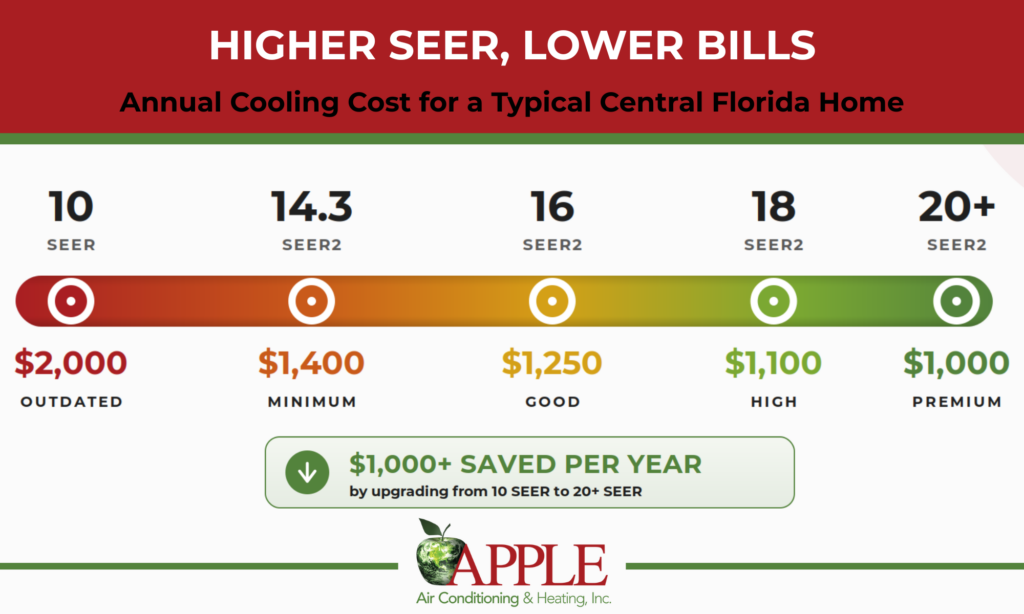
Your actual numbers will depend on home size, insulation, thermostat settings, and electricity rates, but real-world long-term savings on a high SEER unit can add up to thousands of dollars over the 12 to 15 year life of the system.
There is also a payoff beyond your wallet. Less energy use means lower greenhouse gas emissions, a smaller carbon footprint, and less strain on the Florida power grid during peak summer.
Pro Tip: ENERGY STAR certified central air conditioners are required to exceed the federal minimum SEER. Look for the ENERGY STAR label when you shop. It is a quick way to confirm a unit beats the baseline.
What’s a Good SEER Rating for a Florida Home?
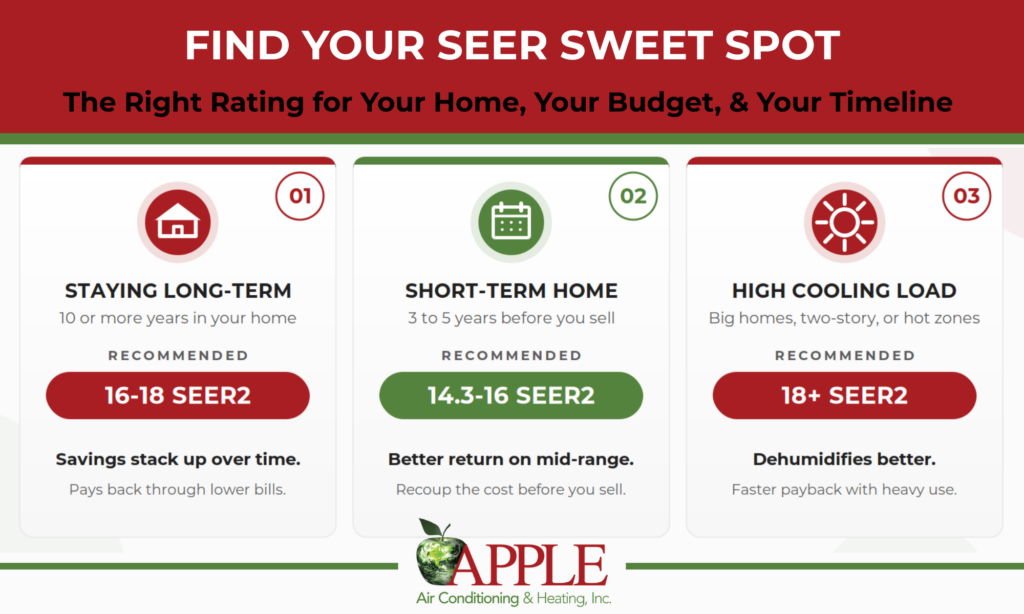
The right SEER rating depends on three things: how long you plan to stay in the home, how much you currently pay for electricity, and how much you want to spend up front.
If you are staying 10 or more years
A 16 to 18 SEER2 system usually makes strong financial sense. Energy savings stack up over time, and the higher equipment cost pays itself back through lower energy costs.
If you are staying 3 to 5 years
A 14.3 to 16 SEER2 system tends to offer the better return. The premium models cost more up front, and you may not be in the home long enough to recoup the difference.
If you have a high cooling load
Larger homes, two-story homes, or homes with poor insulation pull more power. A higher SEER unit can pay for itself faster in those cases. Variable-speed compressors at the top of the SEER range can also run at a lower speed for longer stretches, which dehumidifies better and matters in Central Florida.
Other Factors That Affect Efficiency
A high SEER rating alone will not deliver maximum efficiency if the rest of the system is not right. Efficient systems depend on more than just the rating on the box. A few things to think about:
-
- Sizing. An oversized AC short-cycles, which wastes energy and leaves humidity in the air. A proper Manual J load calculation is the only way to size a new air conditioner correctly.
-
- Ductwork. Leaky or undersized ducts can drop real-world efficiency by 20 to 30 percent. Sealed, properly sized ducts protect your investment in a high-SEER unit.
-
- Maintenance. A dirty coil or clogged filter forces a high-SEER system to work harder than it should. Regular service keeps efficiency where it should be.
-
- Refrigerant. As of January 2025, manufacturers stopped making new systems with R-410A. New installs use lower-impact refrigerants like R-32 and R-454B, which cut greenhouse gas emissions if a system ever leaks.
-
- Thermostat habits. Even the best HVAC system loses ground if the thermostat is constantly set to 68 in July.
When to Upgrade Your AC for Energy Savings
If your current cooling system is over 12 years old, rated at 10 SEER or lower, or breaking down often, an upgrade often pays for itself faster than people expect. Watch for these signs:
-
- Energy bills climbing year over year with no change in usage
-
- Rooms that never get cool enough
-
- Frequent repairs on the same component
-
- Loud noises during start-up or shut-down
When you do upgrade to a new HVAC system, ask your installer for a written load calculation, the SEER2 rating on the equipment, and the warranty terms in writing. That gives you everything you need to make an informed decision and pick the right SEER for your home.
Smarter Cooling Starts Here
A higher SEER rating is one of the simplest ways to bring down your energy bill, lower your carbon footprint, and stay comfortable through Florida summers. The right SEER rating for your home depends on your usage, your budget, and how long you plan to stay, but for most Central Florida families, 16 to 18 SEER2 hits the sweet spot of upfront cost and long-term savings.
Apple AC has been installing efficient HVAC systems across Central Florida since 1997. Our NATE-certified technicians can run a full load calculation, walk you through different options, and give you honest pricing on a new air conditioner that actually fits your home. We also handle maintenance plans, commercial HVAC projects, and indoor air quality upgrades.
Ready to lower your energy costs? Contact Apple AC today to schedule service or request an estimate to find the right SEER rating for your home or business.