

The Short Answer: When your AC is running but not cooling, the most common reasons are a dirty air filter, a thermostat setting problem, a tripped circuit breaker, or low refrigerant from a slow leak. Some fixes you can do yourself in 10 minutes, while others, like a refrigerant leak or a bad AC compressor, call for a professional technician.
If your AC unit is running but the house is not getting cool, the good news is that most cases are common problems with known fixes.
Confirm the Problem
Before tearing anything apart, take 30 seconds to confirm your air conditioner is actually the issue and that you are not feeling hot air from a hot day with poor insulation.
- Stand in front of a vent. Is the air warm, room temperature, or just not cold enough?
- Check the thermostat. Is the set temperature actually lower than the room temperature?
- Listen to the outdoor unit. Is it humming, or completely silent?
- Walk past the indoor air handler. Is the blower running?
7 Common Reasons Your AC Is Not Cooling

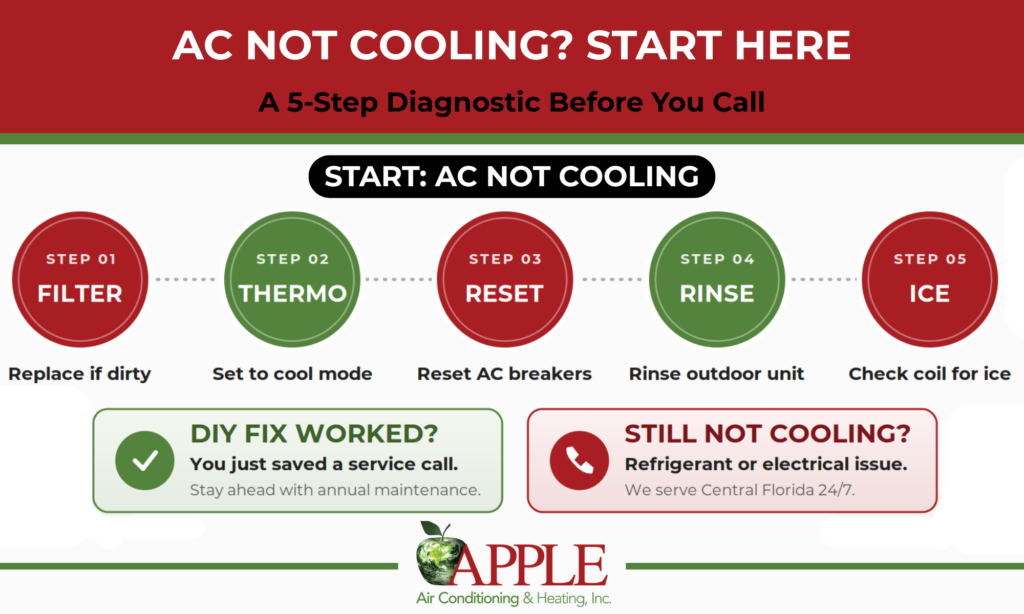
1. Dirty or Clogged Air Filter
A dirty air filter is the single most common reason an AC system fails to cool. The cooling system cannot pull enough air across the evaporator coil when the filter is plugged with dust. Airflow drops, the coil can ice over, and warm air comes out of the vents.
The fix: Pull the air filter out and look at it. If you cannot see light through it, replace it. A clean filter should be swapped in every 1 to 3 months in Florida, more often if you have pets or allergies. Filters cost $5 to $30 at any hardware store.
2. Thermostat Setting or Error
It sounds obvious, but check the thermostat. A thermostat that has lost calibration or has dead batteries will not call for cooling even when the room is warm. If the basics check out and you are still seeing warm air, look for any thermostat error codes on the screen. These usually point to a wiring issue or a failed sensor that needs a pro.
The fix: A simple battery swap can solve the problem in two minutes. If error codes persist after replacing batteries, call a technician.
3. Tripped Circuit Breaker
Most central AC systems run on two breakers: one for the indoor air handler and one for the outdoor condenser unit. If only the indoor unit is running and the outdoor unit is silent, you may have a tripped breaker.
The fix: Check the electrical panel. If a breaker is in the middle or “off” position, flip it fully off, then back on. If it trips again right away, stop. That is an electrical issue that needs a professional. Repeated trips usually point to a bigger problem like a failing compressor or a short.
4. Frozen Evaporator Coil
If your air conditioner has been running constantly and warm air is coming out, look at the indoor coil (the cold metal coil inside your indoor air handler) or the refrigerant line (the insulated copper pipe running between your indoor and outdoor units). A layer of ice on either one means a frozen evaporator coil. This can be caused by a dirty filter, low refrigerant, low fan speed, or a blocked return vent.
The fix: Turn the system off. Set the thermostat to “fan only” and let the ice melt for a few hours. Once it is fully thawed, turn cooling back on. If it freezes again, the underlying problem is still there and you need a service call.
5. Dirty Outdoor Condenser Coil
The outdoor unit pulls heat out of your home and dumps it outside through the condenser coil. When that coil is caked with grass clippings, leaves, or pollen, it cannot release heat fast enough, resulting in a system that runs but barely cools.
The fix: Turn off power to the outdoor unit. Gently rinse the condenser coil with a garden hose from the inside out. Skip the pressure washer (it bends the fins). Keep grass and shrubs at least 2 feet away from the unit. If the coil is heavily fouled or the fins are bent, call a pro.
6. Low Refrigerant or a Refrigerant Leak
Refrigerant is the chemical that absorbs heat inside your home and releases it outside. If you have a low refrigerant level, your air conditioner will run nonstop and barely produce cold air. Refrigerant does not get “used up” the way gas does in a car. A low refrigerant level means you have a leak somewhere, often at an o ring, a flare fitting, or a tiny pinhole in a coil.
The EPA recommends finding and repairing the leak instead of just topping off the refrigerant. Topping off only buys you a few months and wastes money. A real fix might involve UV dye to find the leak, replacing an o ring, sealing a coil, or in worst cases swapping a part.
The fix: This one is for a professional to handle. Federal law requires a Section 608 certified technician to handle refrigerant. A technician will find the leak, repair it, vacuum the system, and recharge the refrigerant pressure to factory spec.
7. Failing AC Compressor
The compressor is the heart of the cooling system. It pressurizes refrigerant and moves it between the indoor and outdoor coils, working with the expansion valve to control flow. When a compressor starts to fail, you may hear odd clicks, hums, or grinding from the outdoor unit. Sometimes the cooling fan motor runs but the compressor never kicks in.
A failing or dead compressor is the most expensive fix on this list. Depending on age and warranty status, replacing it with a new compressor might cost almost as much as a new HVAC system. If your unit is over 10 years old and the compressor is shot, replacement is usually the smarter call.
Where to Find Each Issue
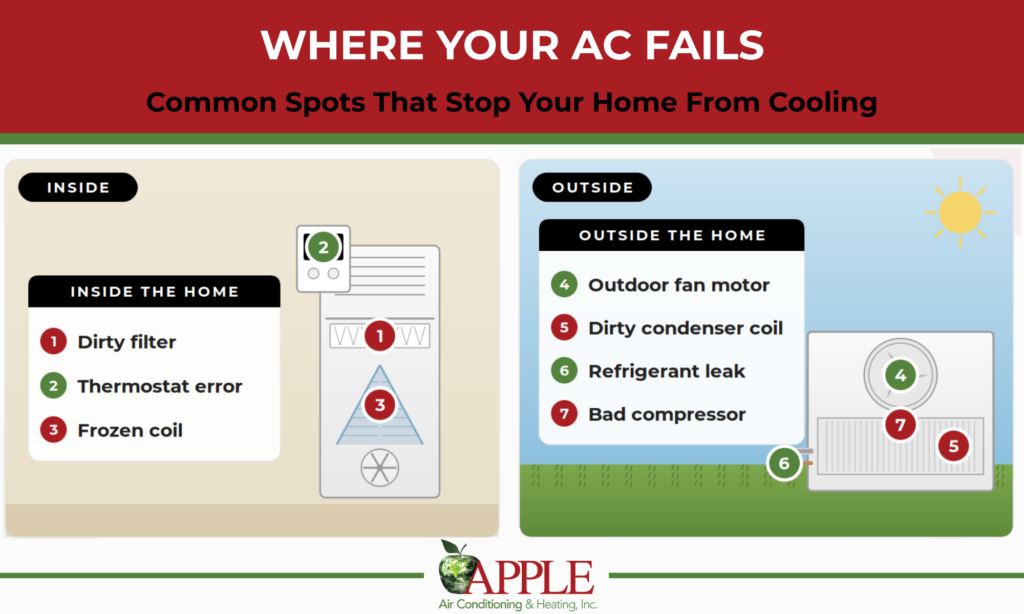
Inside Your Home
1. Dirty filter — Open your air handler cabinet (usually in a closet, garage, or attic). The filter slides out of a slot near the top or side of the unit. Some homes also have a return-air grille filter mounted in a hallway or ceiling.
2. Thermostat — On the wall in your main living area, usually around eye level. Check the screen for cool mode, set temperature, and any error codes.
3. Frozen evaporator coil — Inside your air handler cabinet, behind the filter. Open the access panel and look for ice on the metal coil or on the insulated copper line running out of the unit.
Outside Your Home
4. Outdoor fan motor — The big circular fan on top of your outdoor unit. With the AC running, it should be spinning steadily.
5. Dirty condenser coil — The thin metal fins wrapping around the sides of your outdoor unit. Look for grass clippings, leaves, pollen, or pet hair caked into the fins.
6. Refrigerant leak — Look for an oily residue or hissing sounds along the insulated copper lines connecting your outdoor unit to your house. You will not see refrigerant itself since it evaporates, but oil at the connection points is a giveaway.
7. Failing compressor — Inside the outdoor unit cabinet. You will not see it directly, but listen for unusual clicks, hums, or grinding from the unit. A compressor that hums but never starts is a classic warning sign.
When to Call a Professional

Some AC repairs are safe DIY. Others involve refrigerant, high voltage, or sealed components and require training and certification. Call a professional technician when you see:
- Ice that keeps coming back after thawing
- A breaker that trips again right after you reset it
- Hissing or bubbling sounds near the lines (possible refrigerant leak)
- Burning smells from the air handler or outdoor unit
- The outdoor fan motor running but the compressor silent
- An old AC unit that has been getting weaker year over year
The U.S. Department of Energy notes that regular maintenance keeps an AC system running at peak efficiency and helps prevent these breakdowns in the first place.
Pro Tip: If your AC quits on a weekend night during summer, you do not want to wait three days for a slot. Customers on a maintenance agreement get priority service and reduced or waived after-hours fees. The whole plan pays for itself in a single emergency call.
How to Prevent It From Happening Again
Most AC failures are not freak accidents. They are small problems that grow because no one caught them. A few preventative habits go a long way:
- Change filters on a schedule. Set a reminder every 60 days.
- Schedule annual maintenance. A spring tune-up catches a slow leak, a worn capacitor, or a dirty coil before they cause your system to stop cooling. An AC service agreement bundles two tune-ups a year with priority scheduling and repair discounts, which is the simplest way to stay on top of it.
- Keep the outdoor unit clear. No grass clippings, no shrubs growing into it, no patio furniture leaning against it.
- Watch your energy bill. A bill creeping up month over month is often the first sign of an air conditioner working harder than it should.
- Know your system’s age. A heat pump or central AC over 12 years old is on borrowed time. Plan for replacement before the unit fails.
Your Local AC Pros in Central Florida
Some air conditioner problems you can handle yourself in under an hour, but anything involving refrigerant, electrical issues, or a failing compressor calls for a Section 608 certified technician. The longer a problem goes unaddressed, the more likely it is to turn into a bigger repair bill.
Apple AC has been keeping Central Florida homes and businesses cool since 1997. Our family-run team and NATE-certified technicians handle AC repairs, new installations, commercial HVAC projects, and indoor air quality upgrades with 24/7 availability across many Central Florida counties. Need help right now? Schedule service or request an estimate to speak with a real person fast.